Picture this: You’re strolling through a bustling city street, but your eyes see something extra—a holographic billboard floating above a café, showing a limited-edition coffee blend. Or maybe you’re sitting in a classroom, and the history textbook suddenly comes alive with 3D animations of ancient battles. This isn’t sci-fi; it’s the increasingly tangible world of virtual reality (VR) and augmented reality (AR), technologies that are quietly rewriting how we interact with the world around us.
Smart Glasses: The Challenge of Living Up to Expectations
What Comes to Mind When You Hear “Smart Glasses”?

For those unfamiliar with the smart glasses market and only exposed through media reports, the term likely conjures images of futuristic “eyewear computers” with powerful computing capabilities, environmental sensing, and AR display functions.
However, those who have actually used such products know that current “smart glasses” often fail to live up to their name. According to data released by Runto Technology, approximately 116,000 smart glasses were sold in China during Q1 2024, but only 16,000 of these had camera functionality. In other words, the remaining “smart glasses” are essentially just glasses-shaped “ear-worn smart speakers” without any real environmental awareness.
Why Is This the Case?
Profitability Challenges
The profitability of “smart glasses” may be far lower than many imagine. Taking the current best-selling Meta Ray-Ban as an example, data suggests its BOM (Bill of Materials) cost reaches 58% of its retail price. When factoring in R&D, sales, and operational costs, the actual profit margin is likely significantly lower than conventional consumer electronics like computers and smartphones.
Technical Limitations
Even high-end models like the Meta Ray-Ban are constrained by their form factor and current technology. They cannot match the on-device AI performance of flagship smartphones, let alone deliver the augmented reality display and interaction capabilities seen in science fiction films.
Alibaba’s “Wow Quark Glasses” Debuts: A New Giant Enters the “Hundred Glasses War”
Recently, a domestic smart glasses product has broken through some of these limitations, achieving more comprehensive environmental awareness, augmented reality display, and deeper integration of AI into users’ daily lives.
This is Alibaba’s newly unveiled flagship AI glasses, the “Wow Quark Glasses,” announced during the 2025 World Artificial Intelligence Conference (WAIC 2025), marking their official entry into this round of the “Hundred Glasses War.”
Demonstrated Capabilities
Alibaba has showcased the Wow Quark Glasses’ navigation, photography, and swappable battery features. The glasses combine camera technology, micro-display systems, and voice interaction capabilities while deeply integrating large model technologies from various Alibaba business units. Through cameras and microphones, they achieve dual “visual” and “auditory” environmental awareness.
Beyond common features like Q&A and voice memos, the glasses can perform object recognition, price checking, text translation, and scanning - capabilities previously absent in most smart glasses products.
Why Does Alibaba’s Product Stand Out?
From a software perspective, collaboration between multiple Alibaba divisions has been crucial. Reports suggest the Wow Quark Glasses were jointly developed by Quark, Taobao, Amap, and other teams, involving large model integration, human-computer interaction optimization, and AI perception implementation. The result is deep integration with Alibaba’s ecosystem while pioneering a new approach to consolidating various smart glasses functionalities.
Advanced Dual-Processor Design and Domestic Storage Technology
While Alibaba hasn’t revealed full specifications (only confirming completion of R&D and planned release within the year), leaks have exposed some hardware details:
Computing Platform
The Wow Quark Glasses reportedly use a dual-chip solution: Qualcomm’s Snapdragon AR1 + Bestechnic’s BES2800. While the Snapdragon AR1 is familiar (used in many camera-equipped smart glasses), the BES2800 represents new innovation.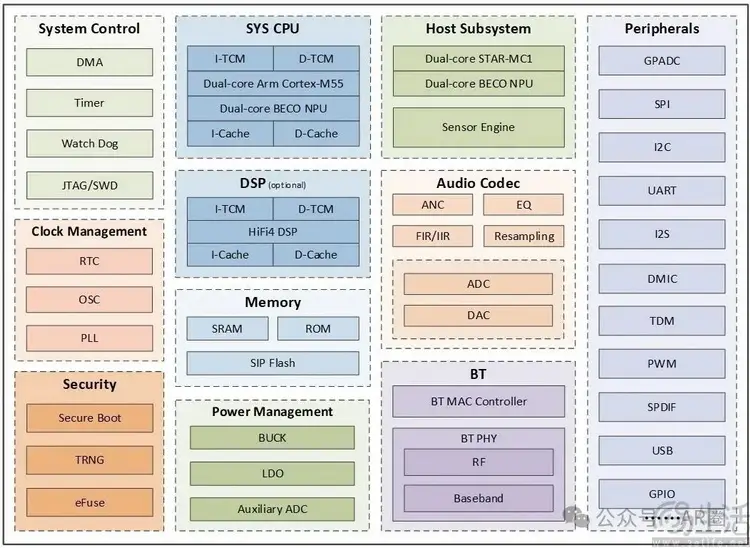
BES2800 Upgrades (vs. BES2700):
- Process node: 12nm → 6nm
- CPU architecture: Single-core → Dual-core (both main and co-processors)
- NPU count: 4× increase
This allows the BES2800 to independently handle health monitoring and AI voice interaction, boosting performance while reducing typical power consumption.
Space Constraints Challenge
The biggest challenge for modern smart glasses lies in balancing performance with slim, lightweight designs. For feature-rich models like the Wow Quark Glasses (with voice interaction, displays, and vision applications), even using a “rear-mounted motherboard” design leaves internal space extremely limited after incorporating optical engines, cameras, high-performance SoCs, and stereo speakers.
Storage Breakthrough: Longsys’ ePOP4x
The glasses reportedly use storage solutions from Longsys. While specific models aren’t confirmed, Longsys recently announced their ultra-thin 0.6mm ePOP4x - a stacked memory+flash storage solution.
Conventional vs. ePOP4x:
| Metric | Traditional (LPDDR4X + eMMC) | Longsys ePOP4x |
|---|---|---|
| Area | ~150mm² each | 76mm² combined |
| Height | >1mm | 0.6mm max |
| Installation | Separate placement | SoC-stacked |
This design dramatically saves precious internal space in wearables. Notably, this isn’t Longsys’ first smart glasses collaboration - their Subsize eMMC (used in XREAL One AR glasses) previously halved conventional eMMC sizes. The newer ePOP4x offers smaller size, higher integration, and larger capacity, providing critical hardware support for high-performance smart glasses and on-device AI. Longsys’ next-gen ePOP5x is reportedly launching this year with further improvements in performance, power efficiency, and compactness.
Not “Overtaking on the Curve”: Domestic Supply Chain Seizes Initiative in “Hundred Glasses War”
Industry observers will recognize the “Hundred Glasses War” concept - the intense competition among global companies to develop smart glasses as the next computing platform after smartphones and capture this emerging device category.
However, neither market size nor user experience has yet produced a clear leader in smart glasses’ software or hardware. In this context, China’s supply chain players are increasingly taking initiative.
Domestic Advantages:
On-Device AI Optimization
- Companies like DeepSeek and Alibaba Qwen have successfully adapted diluted, quantized large models to reduce compute requirements
- Enables faster deployment of AI features (even in compact devices like smartwatches) compared to international competitors
- Creates more intuitive interactions and lowers usage barriers
High-Efficiency Hardware Ecosystem
- Longsys: Leverages in-house packaging/testing facilities for customized PTM solutions (packaging memory, storage, controllers)
- Bestechnic: BES2800 uses Arm China’s STAR-MC1 embedded processors (Armv8-M architecture) designed for IoT/low-power devices
- Component Leaders:
- AAC (speakers)
- Sunny Optical (lenses)
- Luxshare (hinges)
All have achieved world-class status in their respective fields
Strategic Implications
Unlike mature industries like smartphones and EVs where Chinese companies compete while acknowledging foreign patent leadership, smart glasses represent a different scenario:
- Current Phase: Still in rapid development, not yet mainstream
- China’s Role: Likely to play foundational rather than catch-up role
- Nature of Advantage: Not “overtaking” but establishing first-mover technological standards
This represents genuine “first-mover advantage” through technological capability rather than imitation.
Ready to Upgrade Your Eyewear Supply Chain?
If you are looking for a reliable and high-quality partner, Contact Hermitin Optical’s OEM Factory today. With dual manufacturing bases in Danyang and Taizhou, we provide scalable low MOQ custom manufacturing and over 100,000 ready-to-ship wholesale frames. Let’s build your eyewear brand together!